

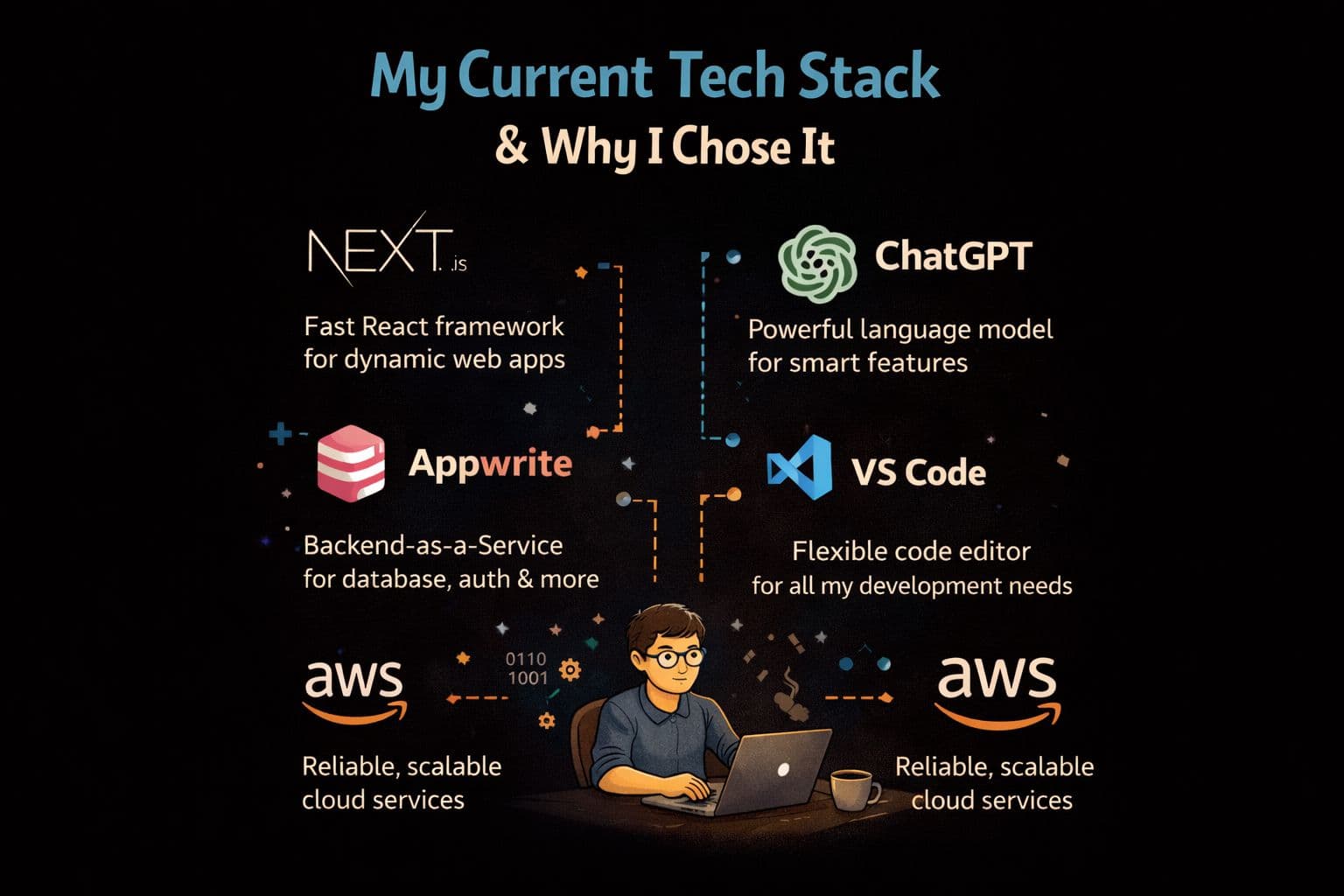
My Current Tech Stack & Why I Chose It
A deep dive into my preferred tools and technologies for 2026, focusing on performance, scalability, and developer experience.
In the rapidly evolving landscape of web development, choosing the right tools is critical. As we step into 2026, the ecosystem has matured significantly, offering deeper integrations and better performance than ever before. Here is a breakdown of my current tech stack and the reasoning behind each choice.
This stack focuses on Performance, Scalability, and Developer Experience (DX). It allows for rapid prototyping without sacrificing long-term maintainability.
The Core: Frontend Framework
Next.js 15 & React 19
Next.js remains the backbone of my projects. With version 15, the improvements in Server Components and the new caching strategies have made it indispensable. I used to struggle with waterfalls and SEO optimization in pure React apps, but Next.js solves this out of the box.
- Why I chose it:
- Server Actions: Seamlessly handle data mutations without creating separate API routes.
- React 19 Integration: Full support for the latest React features like the
usehook and improved hydration. - Performance: Automatic optimization of fonts, images, and scripts.
 typescript
// Example of a Server Action in Next.js 15
async function createPost(formData: FormData) {
'use server'
const title = formData.get('title')
await db.posts.create({ title })
}Styling & Animation
Tailwind CSS & Framer Motion
For styling, Tailwind CSS is a no-brainer. It keeps the codebase clean and ensures consistency. For interactions, Framer Motion brings the UI to life. I simply cannot go back to writing vanilla CSS files where understanding the cascade becomes a nightmare.
- Tailwind CSS: Utility-first approach speeds up development and ensures a cohesive design system.
- Framer Motion: Declarative animations that are easy to implement and highly performant.
- GSAP: for complex, timeline-based animations that require precise control (like the command menu on this site).
Language and Type Safety
TypeScript
I can't imagine writing JavaScript without TypeScript anymore. The type safety it provides eliminates entire classes of bugs before the code even runs. It's not just about types; it's about the confidence to refactor code without breaking things.
Type Defintions
Defining interfaces for props and API responses to ensure data consistency.
Autocomplete
Enjoying rich IDE support and instant documentation while typing.
Refactoring
Making large-scale changes with confidence, knowing the compiler has my back.
Backend & Database
Node.js & Appwrite
For the backend, I leverage Node.js for its non-blocking I/O and vast ecosystem. Appwrite serves as my backend-as-a-service (BaaS) solution, handling authentication, databases, and storage. It allows me to punch above my weight class as a solo developer.
- Appwrite: Open-source and self-hostable, it provides everything needed to build secure and scalable apps quickly.
Conclusion
This stack allows me to build high-quality web applications efficiently. It strikes the perfect balance between bleeding-edge features and stability. As technology continues to advance, so will this stack, but for now, this is the foundation I trust.

Author Parth Sharma
Full-Stack Developer, Freelancer, & Founder. Obsessed with crafting pixel-perfect, high-performance web experiences that feel alive.
The Reality of Shipping Products as a Student in India
Next Article →Designing Fluid Interfaces: My Approach to Animation
Discussion0
Join the conversation
Sign in to leave a comment, like, or reply.
No comments yet. Start the discussion!