

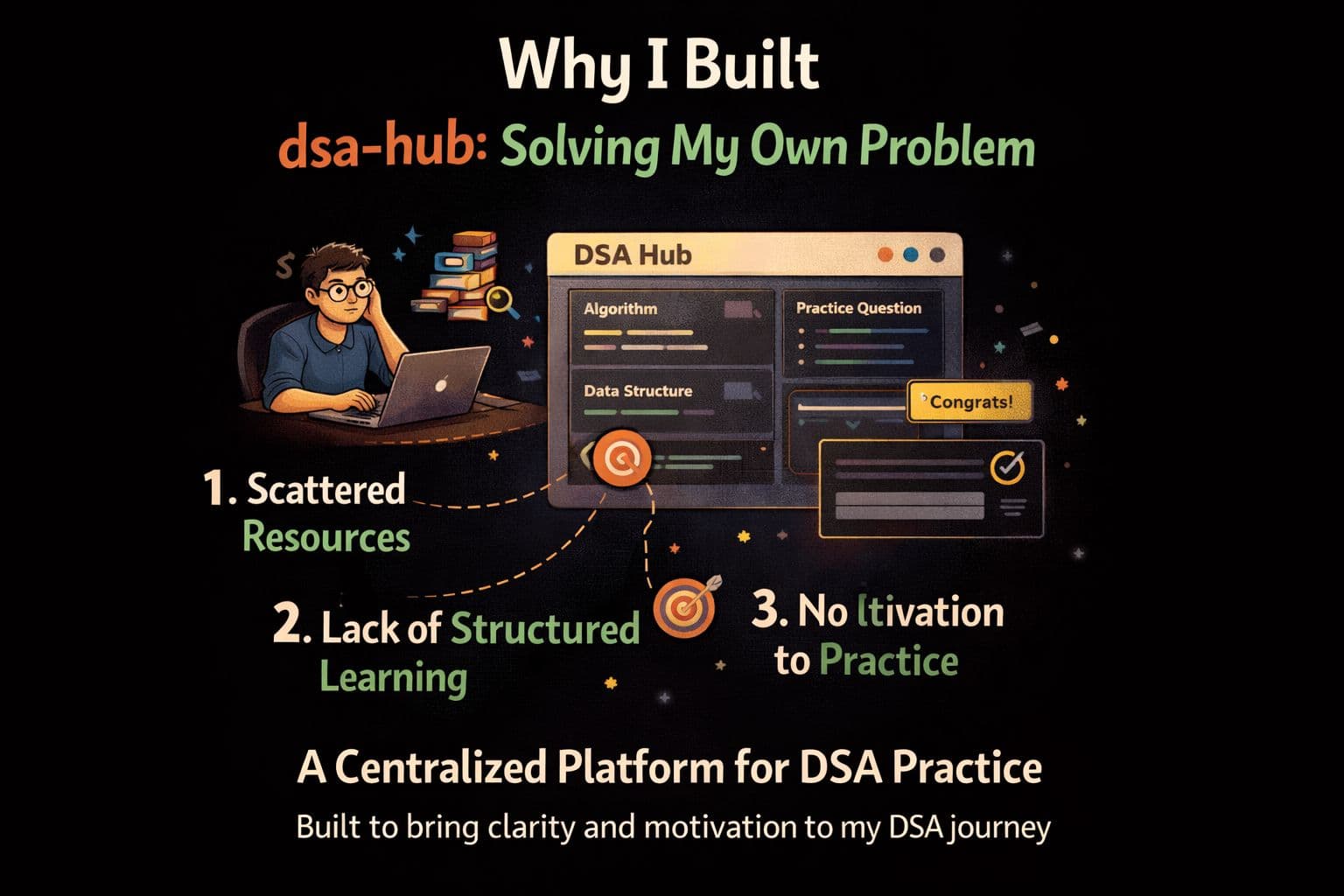
Why I Built dsa-hub: Solving My Own Problem

The story behind building a real-time collaborative code editor for DSA practice. From the frustration of scattered resources to learning WebSockets and CRDTs.
Every great project starts with a personal frustration. For me, dsa-hub wasn't just another resume filler; it was a tool I desperately needed.
As I was grinding LeetCode with my friends, we faced a simple but annoying problem: Peer programming was painful. We were juggling Zoom screen shares, Discord snippets, and delayed feedback loops. I wanted something that felt like sitting next to each other, even when we were miles apart.
The Problem: Friction
Practice needs to be frictionless. If setup takes 10 minutes, you're already drained before you solve the first Two Sum.
A one-click, real-time collaborative environment with integrated video chat and a shared code editor.
The Tech: Real-Time is Hard
Building a collaborative editor sounds simple until you hear the acronym CRDT (Conflict-free Replicated Data Types). Ensuring that User A's typing doesn't overwrite User B's deletions is a complex distributed systems problem.
I chose Socket.io for the real-time transport because of its reliability and room-based features.
The Outcome
After weeks of debugging race conditions and maximizing server uptime on a free tier, we finally shipped.
- Zero Friction: No login required to start a room.
- Integrated Video: Built with WebRTC.
- Outcome: My friends and I successfully used it for our placement prep.
Building dsa-hub taught me that the best products don't always need AI or blockchain. Sometimes, they just need to solve a boring problem really, really well.

Author Parth Sharma
Full-Stack Developer, Freelancer, & Founder. Obsessed with crafting pixel-perfect, high-performance web experiences that feel alive.