

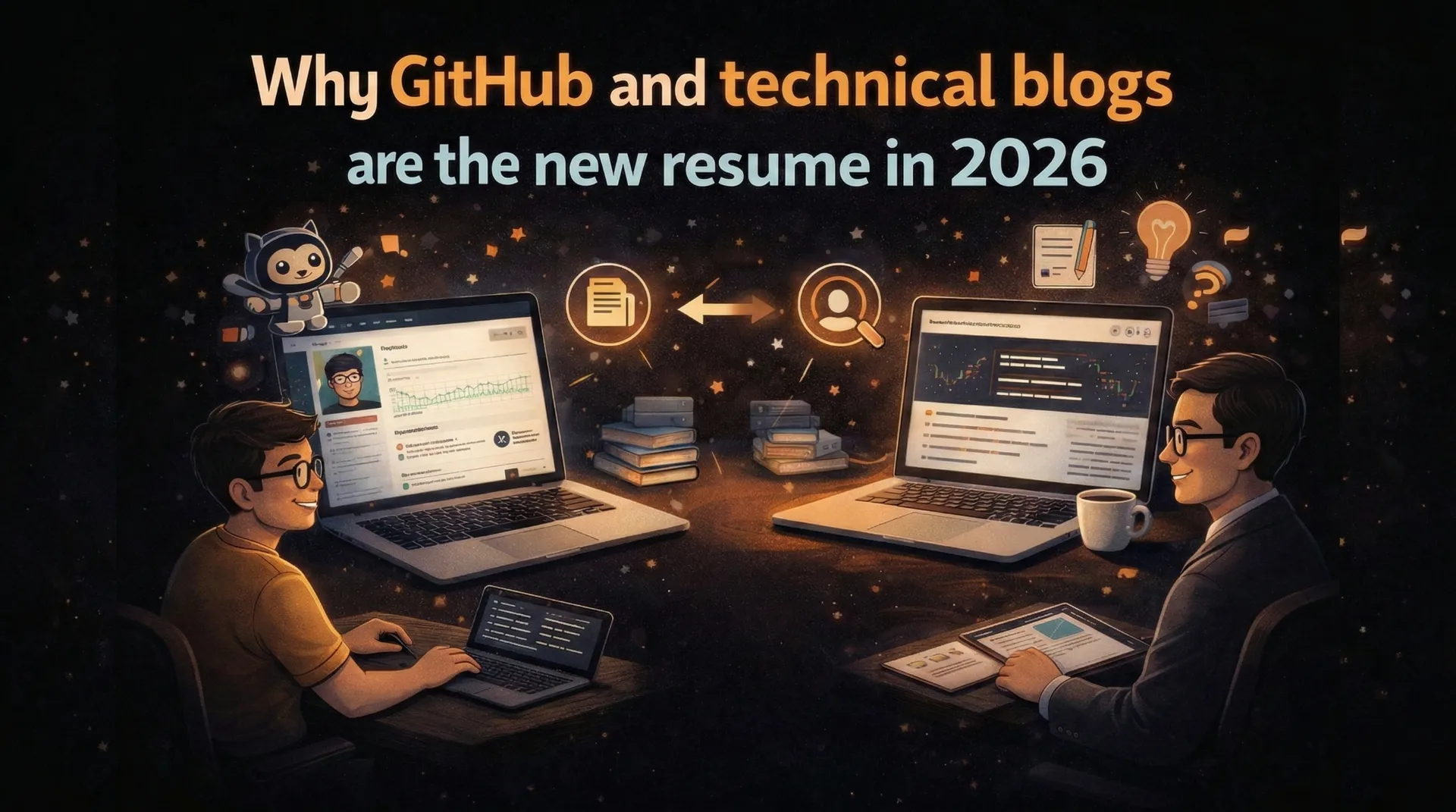
Why GitHub and Technical Blogs Are the New Resume in 2026

Your one-page PDF resume is being filtered out by AI. Here is why your GitHub contribution graph and blog are the only things hiring managers actually trust in 2026.
Your one-page PDF resume is being filtered out by AI. Here is why your GitHub contribution graph and blog are the only things hiring managers actually trust.
Let me paint a picture that is happening right now in 2026: a hiring manager opens their Applicant Tracking System and sees 400 applications for a single mid-level frontend role. At least 200 of them were generated or heavily polished by ChatGPT or Claude. The bullet points are immaculate. The formatting is flawless. The action verbs are perfectly calibrated.
And every single one looks exactly the same.
The AI Resume Flood
This is not speculation. Recruiters I have spoken to at Indian tech companies and startups have confirmed this: AI-generated resumes have made traditional screening nearly impossible.
When everyone uses AI to write "Developed a scalable microservices architecture that improved response times by 40%," nobody's resume stands out. The ATS becomes a lottery, not a filter.
The natural response from hiring managers? They skip the resume entirely and go straight to signals that are much harder to fake:
- Your GitHub profile
- Your technical blog
- Your commit history
Why GitHub Is the New Interview
Think about what a GitHub profile reveals that a resume never can:
| Resume Says | GitHub Proves |
|---|---|
| "Proficient in TypeScript" | Actual TypeScript code they can read and evaluate |
| "Experience with React" | Component architecture decisions, state management choices |
| "Strong problem-solving skills" | Commit history showing how they debug and iterate |
| "Team player" | PR reviews, issue discussions, collaborative patterns |
| "Attention to detail" | Code quality, test coverage, meaningful commit messages |
A resume is a claim. GitHub is evidence.
What Hiring Managers Actually Look At
I have talked to developers who hire, and here is what they check on your GitHub before even scheduling an interview:
Contribution Graph Activity
Not the raw green squares, but the consistency. Are you shipping regularly, or did you push 100 commits in one weekend for a hackathon and then disappear for 6 months? Regular activity signals genuine engagement with code.
Repository Quality Over Quantity
One well-structured, documented project with a clear README is worth more than 30 forked repos with no changes. They look for projects that solve real problems and demonstrate end-to-end thinking.
Commit Messages and History
This is the secret signal. Developers who write meaningful commit messages like "fix: resolve hydration mismatch in MDX image component" demonstrate engineering discipline. Those who write "fixed stuff" or "asdfgh" reveal carelessness.
README Quality
A project with a professional README with screenshots, setup instructions, architecture decisions, and tech stack justification shows you can communicate technical decisions. This is a critical skill in any engineering team.
Why Technical Blogs Are Even More Powerful
GitHub shows you can write code. A technical blog shows you can think.
Here is the thing about blogging that most developers underestimate: the act of writing forces you to understand a topic at a fundamentally deeper level. You cannot fake depth in a 2,000-word technical post the way you can in a 2-line resume bullet.
If you cannot explain a concept clearly in writing, you do not truly understand it. Technical blogs are the Feynman Technique applied to engineering.
What a Blog Proves to Employers
- Communication Skills: The number one complaint from engineering managers is that developers cannot communicate clearly. A well-written blog demolishes this concern.
- Depth of Knowledge: Anyone can list "Next.js" on a resume. Writing a post about "How I Fixed a 3-Second LCP in Next.js by Migrating to Server Components" proves you actually understand it.
- Learning Velocity: A blog with posts spanning different topics like animation, performance, system design, and AI shows you are a fast learner who adapts quickly.
- Initiative: Nobody asked you to write a blog. Doing it anyway signals self-motivation and genuine passion for the craft.
Blog Topics That Actually Impress
Not all blog posts are created equal. Here is what resonates with hiring managers versus what gets ignored:
| Impressive | Forgettable |
|---|---|
| "How I Built X and What I Learned" | "What is React? A Beginner's Guide" |
| "Debugging a Production Memory Leak in Node.js" | "Top 10 VS Code Extensions" |
| "Why I Chose Supabase Over Firebase for a Client Project" | "Firebase vs Supabase Comparison (rewritten from docs)" |
| "Performance Teardown: Achieving 100 Lighthouse Score" | "How to Install Tailwind CSS" |
| "Lessons from Shipping a Product for a Real Client" | "My Journey Learning to Code" (without specifics) |
The pattern is clear: specificity and personal experience win. Hiring managers can smell rewritten documentation from a mile away. What they cannot fake is your unique story of building, debugging, and shipping.
The "Proof of Work" Model
I think about this in terms of Proof of Work, a concept borrowed from cryptocurrency. In hiring, your "proof of work" is the verifiable trail of evidence that you have actually built, struggled, and shipped.
Your resume is a self-reported summary. Your GitHub and blog are cryptographic-level proof that you can do what you claim.
More companies are adopting asynchronous hiring processes in 2026. They send you a repo to review, or ask you to submit a PR to a sample project. Your GitHub history is essentially a pre-completed take-home test.
How to Build Your "Technical Resume" Starting Today
If your GitHub is mostly empty forks and your blog does not exist, here is how to start:
Clean Up Your GitHub Profile
Pin your 4-6 best repositories. Write proper READMEs with screenshots, tech stack, and setup instructions. Archive or make private any repos that are embarrassing. Add a profile README with a brief intro and links to your blog.
Ship One Real Project
Not a tutorial clone. Build something that solves a problem you actually have. Deploy it. Get users. Even 10 real users is more impressive than a portfolio of undeployed projects.
Start Writing, Even If It Is Messy
Your first blog post will not be perfect. That is fine. Write about what you built, what broke, and what you learned. Authenticity trumps polish every single time.
Be Consistent
One blog post per month and regular GitHub commits build a pattern that recruiters notice. It is not about volume, it is about showing sustained engagement with your craft.
In 2026, your online presence is your resume. A strong GitHub profile and a thoughtful technical blog will open more doors than any PDF ever could. The best part? Unlike a resume that you update for each application, your GitHub and blog work for you 24/7, even while you sleep.
The Indian Developer Advantage
Here is something I have noticed specifically in the Indian tech ecosystem: companies are increasingly reaching out to developers on GitHub and Twitter (X) directly. The traditional naukri.com / internshala pipeline is getting flooded with AI-generated applications.
But a developer in Pune who has a well-maintained GitHub with a Next.js project and 5 blog posts about their engineering decisions? That person gets cold DMs from CTOs.
I have seen it happen. I have experienced it happen.
The barrier to entry is lower than you think. You do not need a CS degree from an IIT. You do not need 10,000 GitHub stars. You need consistent, visible, genuine work that speaks for itself.
Start today. Push that commit. Publish that post. Your future self will thank you.
What has been your experience with the hiring landscape in 2026? Are resumes still working for you, or have you noticed the shift? Let me know in the comments.

Author Parth Sharma
Full-Stack Developer, Freelancer, & Founder. Obsessed with crafting pixel-perfect, high-performance web experiences that feel alive.