

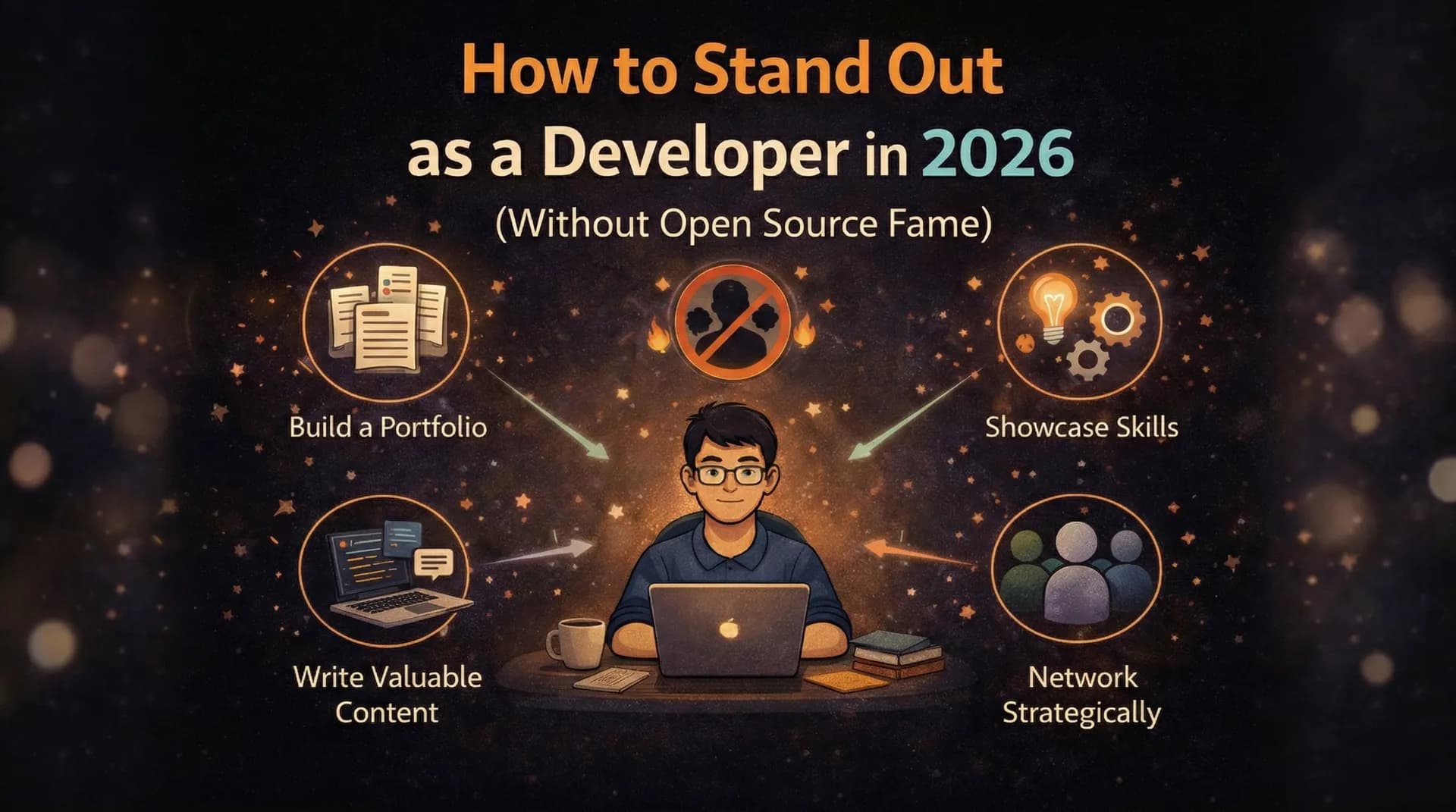
How to Stand Out as a Developer in 2026 (Without Open Source Fame)

You don't need 10k GitHub stars to land a top-tier role. Here is the realistic playbook to stand out when everyone else is just grinding algorithms.
You don't need 10k GitHub stars to land a top-tier role. Here is the realistic playbook to stand out when everyone else is just grinding algorithms.
Let me address the elephant in the room: the internet loves to tell developers that they need to be open source famous to get ahead. Contribute to Next.js. Build a popular npm package. Get invited to speak at conferences. Become a "developer influencer."
For 99% of us, that is not going to happen. And that is completely fine.
I am a working developer in India. I do not have a viral open source project. I have never spoken at a major conference. But I have landed client work, built real products, and created a visible online presence that gets noticed. Here is exactly how.
The Myth of Open Source Fame
The problem with the "contribute to open source" advice is that it ignores a brutal reality: the top open source projects are incredibly competitive and intimidating for newcomers.
Opening a PR to React, Next.js, or VS Code requires deep understanding of massive codebases, complex CI/CD pipelines, and often weeks of context-gathering before you can even find a "good first issue" that has not already been claimed.
Does that mean open source does not matter? No. But it means there is a much more accessible path to standing out as a developer in 2026.
The "Proof of Work" Framework
Instead of chasing GitHub stars, focus on building irrefutable proof that you can ship real products. I call this the "Proof of Work" framework, and it has three pillars:
1. Ship End-to-End Products
The single most impressive thing on a developer's portfolio is a deployed, working product that solves a real problem. Not a tutorial clone. Not a half-finished project. A real thing that people can use.
Here is why this matters more than open source contributions:
| Open Source Contribution | Shipped Product |
|---|---|
| Fixed a typo in docs | Built, deployed, and maintained an app |
| Added a small feature to someone else's project | Made every architectural decision yourself |
| Context-switching across unfamiliar codebases | Deep expertise in your own stack |
| Dependent on maintainer's review timeline | You own the entire lifecycle |
When I built a real-time analytics dashboard for a client, it was not a clone of some tutorial project. It was a solution to a specific business problem: the client needed live data visualizations with WebSocket updates and role-based access control. I wrote about the challenges, deployed it, and it served real users in production.
That single shipped project has opened more doors than any number of "good first issue" PRs ever could.
Identify a Real Problem
Start with your own frustrations or a client's pain point. What tool do you wish existed? What workflow annoys you? The best project ideas come from genuine needs, not "project ideas for your portfolio" lists.
Build the MVP
Do not over-engineer. Ship the smallest possible version that solves the core problem. You can iterate later. The point is to get something live and usable.
Deploy and Get Real Users
Even 10 real users transforms your project from a "personal project" to a "product." Share it on Reddit, Twitter, or in relevant communities. Real user feedback is gold.
Document Everything
Write a blog post about the journey. Record the technical decisions, trade-offs, and things you learned. This documentation becomes your strongest interview material.
2. Documentation as a Superpower
Most developers underestimate how powerful good documentation is. I am not talking about code comments (though those matter too). I am talking about:
- Detailed README files that explain why you made certain choices, not just what the project does
- Architecture Decision Records (ADRs) in your repo explaining trade-offs
- Blog posts that walk through your thought process
Here is the thing hiring managers have told me repeatedly: the ability to communicate technical decisions clearly is rarer, and more valued, than raw coding skill.
A decision record like this in your repo tells an employer more about your engineering maturity than a LeetCode rating ever will.
3. Build in Public
You do not need a massive following to "build in public." You just need to share your work regularly in spaces where developers hang out.
I post updates about client work and side projects on Twitter (X) and write about my decisions on my blog. I do not have a huge audience. But when a recruiter or hiring manager searches my name, they find a trail of consistent, genuine engineering work, not just a LinkedIn profile with buzzwords.
Building in public does several things:
- Creates a searchable history of your engineering journey
- Builds credibility incrementally over time
- Attracts serendipitous opportunities (cold DMs from CTOs, collab invitations)
- Forces you to articulate your decisions, which makes you a better engineer
The Realistic Playbook
Here is the exact strategy I would follow if I were starting from scratch in 2026:
Month 1-2: Foundation
- Clean up GitHub. Pin your best 4-6 repos. Write proper READMEs. Archive junk.
- Start a blog. Even a simple Next.js MDX blog. Publish your first post about something you recently learned.
- Identify your project. What problem will you solve? Start building the MVP.
Month 3-4: Shipping
- Deploy the MVP. Use Vercel, Railway, or any free tier. Get it live.
- Write a case study. Document the technical decisions, challenges, and outcomes.
- Share it. Post on Twitter, Reddit (r/webdev, r/nextjs), and Dev.to. Do not be salesy, just share what you built and learned.
Month 5-6: Compounding
- Iterate based on feedback. Add features users actually requested. Fix bugs.
- Write 2-3 more blog posts. Deep dives into specific technical challenges you faced.
- Engage with the community. Answer questions on Discord servers, review others' projects, be helpful.
By month 6, you will have:
- A deployed product with real users
- A GitHub profile that demonstrates end-to-end capability
- A blog with technical depth
- A growing network of developers who know your work
That beats "contributed to 3 open source projects" on any resume.
What Hiring Managers Actually Want in 2026
Based on conversations with developers who hire at startups and mid-size companies in India, here is what they look for:
Shipped Product + Clear Documentation + Consistent Activity > FAANG Resume + LeetCode Rating + Open Source Stars
The hiring market in 2026 is saturated with algorithm grinders. What is genuinely scarce:
- Developers who can take a vague requirement and turn it into a deployed product
- Developers who can explain their technical decisions in writing
- Developers who show consistent growth over months, not just burst activity
You do not need to be famous. You need to be findable, credible, and clearly capable.
My Personal Stack for Standing Out
For reference, here is what I use to build my "proof of work":
- Portfolio: A Next.js site with blogs, projects, and interactive demos
- Blog: MDX posts with real technical depth (not just "how to install X")
- GitHub: Clean repos with READMEs, meaningful commits, and deployed demos
- Twitter (X): Sharing build updates, learnings, and connecting with other builders
- Client Work: Real products shipped for real businesses with measurable outcomes
None of this requires open source fame. All of it is achievable as a student, a self-taught developer, or someone early in their career.
The bar is lower than you think. The payoff is higher than you imagine.
Start shipping.
What is your strategy for standing out in 2026? I would love to hear what is working for you. Drop a comment or reach out.

Author Parth Sharma
Full-Stack Developer, Freelancer, & Founder. Obsessed with crafting pixel-perfect, high-performance web experiences that feel alive.