

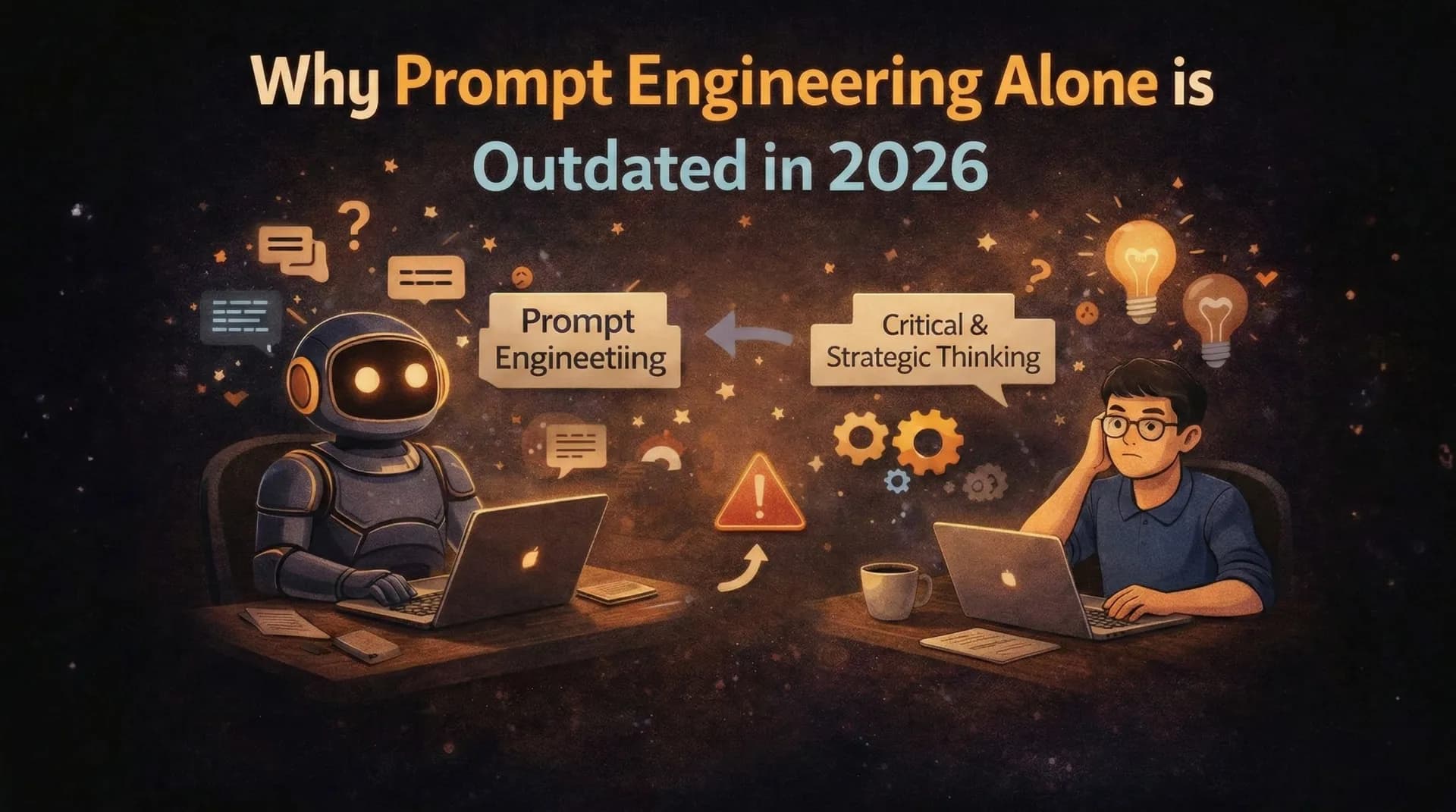
Why Prompt Engineering Alone Is Outdated in 2026

If you are still tweaking 'act as an expert' prompts, you are falling behind. Here is the actual engineering skill replacing it in 2026: system architecture, clean data pipelines, and agentic workflows.
If you are still tweaking "act as an expert" prompts, you are falling behind. Here is the actual engineering skill replacing it in 2026.
I know this is a hot take. Prompt engineering was the in-demand skill of 2024. LinkedIn influencers built entire careers around it. Courses sold for hundreds of dollars. "10x your productivity with this one prompt template!"
But here in 2026, I am going to argue something uncomfortable: prompt engineering as a standalone skill is dead. What matters now is something fundamentally harder, and far more valuable.
The Rise and Plateau of Prompt Engineering
Let me be clear: prompts still matter. Writing a clear, well-structured instruction to an LLM will always beat a vague one. That is not controversial.
What is controversial is the idea that spending hours tweaking prompt phrasing is the highest-leverage activity for an AI-powered developer.
The developers who obsess over "chain-of-thought" prompt templates are optimizing the wrong layer of the stack. It is like spending hours perfecting your CSS while your database queries take 4 seconds each.
The models got smarter. Claude Opus 4.6, GPT-5.3 Codex, and Gemini 3 Pro are dramatically better at understanding ambiguous instructions than their predecessors. The gap between a "perfect" prompt and a "decent" prompt has narrowed significantly.
What has not narrowed is the gap between developers who understand system-level AI integration and those who only know how to write good prompts.
What Actually Replaced Prompt Engineering
1. Agentic Architecture
The biggest shift in 2026 is the move from single-prompt interactions to multi-agent workflows. Instead of crafting one perfect prompt, you design a system of agents that collaborate.
When I use Claude Code for complex refactoring on a client project, I do not write one massive prompt. I set up agent teams:
The architecture of how agents interact matters 10x more than the exact wording of any individual prompt.
Design the Pipeline First
Before touching a prompt, map out the data flow. What does each agent receive? What does it output? Where do handoffs happen? Think of it like designing a microservices architecture, not writing a single function.
Context Management > Prompt Tricks
The most impactful optimization is not phrasing, it is what context reaches the model. Feed an agent your entire 50-file codebase and it drowns. Feed it the 3 relevant files with clear interfaces, and it produces surgical precision.
Error Recovery and Fallbacks
Real agentic systems need error handling. What happens when an agent hallucinates? You design retry logic, validation steps, and human-in-the-loop checkpoints. No prompt template teaches this.
2. Clean Data Pipelines
The second underrated skill is data engineering for AI. Most AI application failures I see in 2026 are not prompt failures, they are data failures.
Your RAG (Retrieval-Augmented Generation) system returns garbage? It is probably not the prompt. It is:
- Chunking strategy: Are you splitting documents at semantic boundaries or arbitrary character counts?
- Embedding quality: Are you using the right embedding model for your domain?
- Retrieval logic: Is your vector search returning genuinely relevant context?
On a recent client project, I spent more time cleaning and structuring the knowledge base data for their AI search feature than I ever spent on any prompt. And that data work had 10x the impact on output quality.
3. Tool Integration and Function Calling
Modern LLMs are not just text generators, they are orchestrators. They call functions, query databases, browse the web, and execute code.
The skill is not "write a prompt that makes GPT do X." The skill is "design a tool schema that makes GPT capable of doing X."
The developer who designs clean tool interfaces will consistently outperform the developer who writes clever prompts.
The Skills That Actually Matter in 2026
Here is what I would invest time learning instead of prompt templates:
| Old Skill (2024) | New Skill (2026) | Why It Matters |
|---|---|---|
| Prompt templates | Agent architecture | Multi-step workflows dominate |
| "Act as an expert" | Context window management | What goes in matters more than how you ask |
| Chain-of-thought prompts | Tool/function design | Models call APIs now, not just generate text |
| One-shot prompt engineering | Data pipeline engineering | RAG quality depends on data, not prompts |
| Temperature tuning | Evaluation frameworks | You need metrics, not vibes |
| Prompt chaining | Error recovery design | Production AI needs fault tolerance |
But Wait, Prompts Are Not Completely Dead
I want to be nuanced here. Prompts are still the interface. You still need to communicate clearly with AI. What I am arguing against is the idea that prompt engineering is a career or a primary skill.
Prompt engineering in 2026 is like knowing how to write good commit messages. It is a baseline expectation, not a differentiator. You should know how to do it, but it will not land you a job or make your product successful on its own.
The developers getting hired for AI roles in 2026 are not "prompt engineers." They are:
- AI Systems Engineers who design multi-agent architectures
- ML Engineers who build evaluation pipelines and fine-tune models
- Full-Stack Engineers who integrate AI into production applications with proper error handling, caching, and observability
What I Do Instead of Prompt Tweaking
When I build AI-powered features for clients, here is my actual process:
- Define the system architecture first. How many agents? What tools do they need?
- Design the data pipeline. What context reaches the model? How is it structured?
- Write minimal, clear prompts. No tricks. Just straightforward instructions.
- Build evaluation tests. Run 50 test cases and measure accuracy, not vibes.
- Iterate on the system, not the prompt. Fix retrieval, add tools, improve context before changing a single word in the prompt.
If you want to stay relevant in the AI-powered development landscape of 2026, stop optimizing prompts and start optimizing systems. Learn agentic architecture. Learn data pipelines. Learn tool design. The prompt is just the tip of the iceberg.
Where to Start
If you are currently deep in prompt engineering and want to level up:
Build an Agent Pipeline
Take a complex task you currently solve with one LLM call and split it into 3 agents. A planner, an executor, and a reviewer. See how the output quality changes.
Learn RAG Properly
Do not just plug in a vector database. Study chunking strategies, embedding models, and hybrid search (keyword + semantic). The difference between bad RAG and good RAG is enormous.
Design Tool Schemas
Practice writing function/tool definitions for LLMs. The clearer your tool interfaces, the more reliably the model uses them.
Set Up Evaluations
Create a test suite for your AI features. Measure accuracy over 50+ examples. Stop shipping AI features based on "it worked when I tried it once."
The future belongs to AI systems engineers, not prompt whisperers. The sooner you make that mental shift, the further ahead you will be.
Did this challenge your perspective? I would love to hear counterarguments in the comments. If prompt engineering is still working for you, tell me how.

Author Parth Sharma
Full-Stack Developer, Freelancer, & Founder. Obsessed with crafting pixel-perfect, high-performance web experiences that feel alive.