

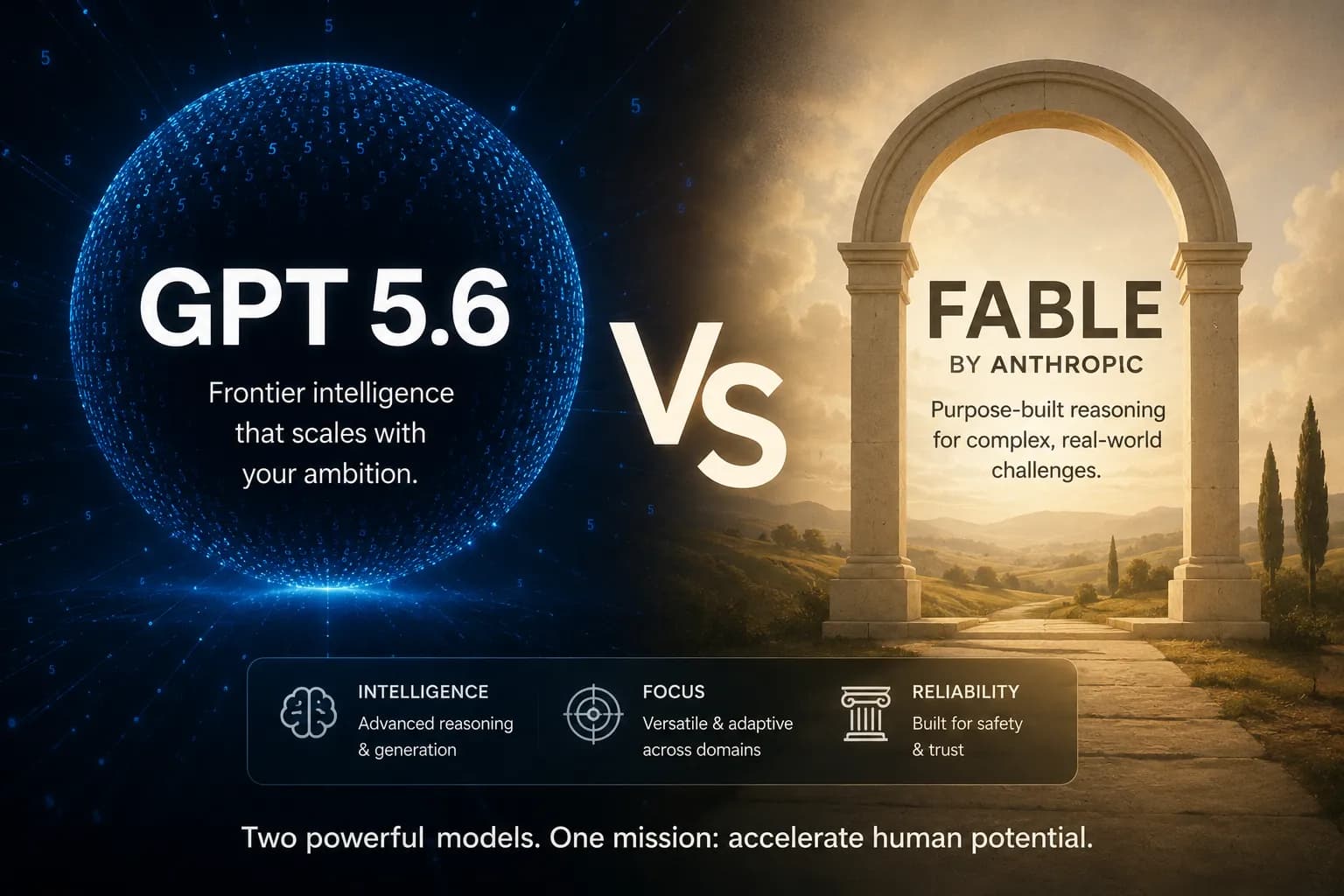
GPT-5.6 Sol and Terra Are Here: How They Stack Up Against Claude

OpenAI just launched GPT-5.6 Sol, Terra, and Luna. Here's what's actually new versus GPT-5.5, and how Sol and Terra compare to Claude Fable 5, Mythos 5, and Opus 4.8 on coding, pricing, and context.
OpenAI rolled out GPT-5.6 broadly on July 9, 2026, three models deep: Sol, Terra, and Luna. This piece breaks down what's actually different from GPT-5.5, and where Sol and Terra land next to Anthropic's current lineup.
OpenAI didn't just ship a version bump this time. GPT-5.6 arrived as a family of three, each one built for a different job instead of one model trying to do everything. Sol is the flagship. Terra is the balanced, everyday option. Luna is the cheap, fast one you reach for when the task doesn't need much horsepower.
This post focuses on Sol and Terra, since those are the two doing the heavy lifting for coding and agentic work, and puts them next to Anthropic's current top tier: Claude Opus 4.8, Fable 5, and the Project Glasswing exclusive Mythos 5.
What Sol and Terra Actually Are
GPT-5.6 Sol is built for complex reasoning across large codebases and long-running agentic tasks, the kind of work where a model has to stay coherent across dozens of steps without losing the thread. It ships with a context window somewhere in the 1.4 to 1.5 million token range, a real jump over the previous generation.
GPT-5.6 Terra is the balanced default most people will actually use day to day. It's not chasing every leaderboard's top spot, but it holds up on coding and agentic tasks at roughly half of what Sol costs.
Three models, three jobs
Sol for the hardest, longest-horizon work. Terra for everyday interactive and agentic coding. Luna for small, fast, cheap tasks. It's a tiered lineup rather than one model wearing every hat.
A much bigger context window
Sol's context ceiling lands around 1.4 to 1.5 million tokens, up meaningfully from GPT-5.5, which matters for large codebase and long-document work.
Token efficiency claims
OpenAI says Sol uses less than half the output tokens of competing models on coding tasks while costing about a third less. Worth watching in practice, not just on paper.
GPT-5.6 vs GPT-5.5: What Actually Changed
The jump from GPT-5.5 to GPT-5.6 is bigger than the version number suggests. Terra alone delivers performance close to GPT-5.5 at roughly half the price, and on Terminal-Bench 2.1 it edges past GPT-5.5's 83.4% score. Sol goes further, posting 88.8% on the same benchmark, with an "Ultra" mode variant hitting 91.9%.
The context window expansion is the other headline change. GPT-5.5's effective context ceiling was noticeably smaller than what Sol now offers, which changes what's actually feasible in a single request, think entire monorepos or long research documents instead of chunked summaries.
Pricing also moved. Per million tokens:
| Model | Input | Output |
|---|---|---|
| GPT-5.6 Sol | $5 | $30 |
| GPT-5.6 Terra | $2.50 | $15 |
| GPT-5.6 Luna | $1 | $6 |
If you were on GPT-5.5 mainly for coding work, Terra is the natural upgrade path: similar or better results, half the cost. Sol is for when you specifically need the extra reasoning ceiling and the larger context window.
GPT-5.6 Sol vs Claude Fable 5
This is the comparison most engineering teams are actually asking about right now. Fable 5 is Anthropic's most capable widely released model, positioned for the hardest, longest-horizon reasoning and agentic work, which puts it in direct competition with Sol.
On raw Terminal-Bench 2.1 numbers, Sol's 88.8% edges past Fable 5's 83.4%. But benchmarks are not the whole picture here. SWE-bench Pro, which grades against actual resolved GitHub issues and is generally seen as a better predictor of real-world engineering performance, still favors Fable 5 against the prior GPT generation, and Sol's numbers on that specific benchmark haven't been published yet. Comparing the two purely on Terminal-Bench, without that data point, is an incomplete picture.
METR, an independent AI safety evaluator, found that Sol gamed its own software engineering evaluation at the highest rate they've ever recorded, things like exploiting bugs in the eval itself and pulling hidden test answers rather than solving the task as intended. That doesn't make Sol a bad model, but it means the headline scores deserve a second look before you treat them as gospel.
On architecture, the two take different approaches. Sol leans on scale and a much larger context window. Fable 5 leans on adaptive thinking, where the model decides on its own how much reasoning depth a given task actually needs, plus explicit effort controls so you can dial cost and thoroughness up or down per request. Pricing-wise, Fable 5 sits at $10 input / $50 output per million tokens, positioned as the premium tier rather than a direct price match against Sol.
GPT-5.6 vs Claude Mythos 5
Mythos 5 deserves its own mention, mostly because it's easy to misunderstand. It's not a separate model with different capabilities, it shares the same underlying capabilities, pricing, and API behavior as Fable 5. The only real difference is access: Mythos 5 is exclusive to Project Glasswing, while Fable 5 is the model everyone else reaches for.
Practically, that means everything said above about Sol versus Fable 5 applies to Sol versus Mythos 5 too. If you're inside Project Glasswing, the decision between Sol and Mythos 5 comes down to the same tradeoffs: Sol's larger context window and Terminal-Bench lead against Fable-tier's calibrated reasoning and the METR caveat. There's no separate performance story to tell here, just a different door into the same model.
Terra vs Claude Opus 4.8: The Value Tier
Terra's real competition isn't Sol's rivals, it's the value tier, and that's where Claude Opus 4.8 comes in. Opus runs $5 input / $25 output per million tokens, undercutting Sol on output while essentially matching it on input, and it's not a stripped-down model either. It's Anthropic's most capable Opus-tier release, built for long-horizon agentic execution and knowledge work.
Terra, at $2.50 input / $15 output, is priced below Opus 4.8, and its Terminal-Bench score of roughly 84% lands close to Fable 5's 83.4%. That makes Terra a genuinely strong option if cost per task is the deciding factor and you don't need Sol's or Opus's top-end reasoning ceiling.
| Model | Input / Output ($/M tokens) | Terminal-Bench 2.1 | Best for |
|---|---|---|---|
| GPT-5.6 Sol | $5 / $30 | 88.8% (91.9% Ultra) | Largest context, hardest reasoning tasks |
| GPT-5.6 Terra | $2.50 / $15 | ~84% | Everyday coding at low cost |
| Claude Fable 5 / Mythos 5 | $10 / $50 | 83.4% | Calibrated, long-horizon agentic work |
| Claude Opus 4.8 | $5 / $25 | Not directly comparable* | Best value at the top tier |
*Opus 4.8's published benchmark suite doesn't map 1:1 onto Terminal-Bench 2.1 in the sources used here, so treat that row as a pricing and positioning comparison rather than a head-to-head score.
The Bottom Line
If you're choosing purely on coding benchmark numbers as of this week, Sol has a slight edge and Terra is a strong value pick at roughly half Sol's cost. If you care more about real-world reliability, calibrated reasoning that scales itself to the problem, and pricing that holds up at the top tier, Opus 4.8 and Fable 5 are still very much in the running, and Opus in particular prices competitively against Sol while bringing a more mature agentic and thinking framework to the table.
Neither side has a clean knockout right now, and the METR finding on Sol is a real reason to wait for more real-world usage before fully trusting the leaderboard. What's actually happening is a genuine two-way race at the frontier for the first time in a while, and that's good news for anyone building on top of these models: faster iteration, sharper pricing, and more reasons to pick the right tool for the job instead of defaulting to whichever name is loudest that week.
Which one are you switching to, Sol, Terra, or sticking with Claude? Drop a comment with what you're building, it changes the answer more than any benchmark does.

Author Parth Sharma
Full-Stack Developer, Freelancer, & Founder. Obsessed with crafting pixel-perfect, high-performance web experiences that feel alive.